Archive for the ‘Politics’ Category
Regulatory Divergence February 21st, 2018
Since the EU referendum, it’s interesting that there still seems to be some reluctance to articulate what the benefits of leaving the EU are. Throughout the referendum, we were told that EU regulation strangles businesses yet there didn’t seem to be anyone that could set out which regulations were actually causing problems. So I was really interested to see Iain Duncan Smith on Daily Politics yesterday actually giving some examples of regulations he would like to get rid of. That’s useful, instead of talking in vague terms it’s something we can genuinely assess whether or not it will be beneficial to us. The four regulations he listed were:
- Clinical Trials Directive
- Mifid II
- Solvency II
- Labelling
You can watch him here. I wouldn’t bother with all of it as it turns into the standard bad-tempered argument after about three minutes.
I thought it might be useful to go through each of these regulations to have a think about whether we really want to get rid of them. There is the caveat that the Clinical Trials Directive is a directive rather than a regulation. The difference being that directives are based on individual countries legislating to achieve shared objectives but that’s just pedantic so I’ll let him have that. Also labelling is a concept rather than a regulation but I’m sure he had specific regulations in mind.
The Clinical Trials Directive – this was brought in to try and get all member states to harmonise the way they carry out clinical trials. That, on the face of it, sounds like a good idea. If you carry out a trial in one country then it should make it easier for that trial to be recognised in another country. Since 2003 there have been many criticisms of how the directive has worked. The bureaucracy involved is said to have reduced clinical trials by as much as 25%. That does sound like Iain might have a point; except we are in the process of getting rid of the directive and replacing it with a new Clinical Trials Regulation that reduces red tape. It’s due to be in place in 2019. Which raises the question of whether Iain wants to get rid of the old one or the new one? Either way, I can’t imagine a situation where UK based pharmaceutical companies will want to conduct trials that are not consistent with EU regulation. Unless of course, they decide that the EU isn’t a market they want to trade in.
Mifid II – The Markets in Financial Instruments Directive (note this is also not a regulation) was created to address some of the issues raised by the 2008 financial crash. Iain raises the point that markets are being destroyed by regulation but surely financial services are the one market where it is obvious we seriously lack regulation? This directive is intended to bring in more protection for investors and make transactions transparent. That sounds pretty good on the face of it. There are concerns that these regulations will reduce payments for research and sales services which might cause stockbrokers to focus on markets outside of the EU. That could be something to be concerned about but it will happen whether we implement the directive or not. If we want to trade financial services into the EU then we will need to be Mifid II compliant. There is also nothing in the regulations that stop stockbrokers focussing on markets outside of the EU at the moment or in the future. There is a moral question here, is financial services an area we really want to deregulate? It went horribly wrong with the regulations we’ve got at the moment, having less of them doesn’t seem a great idea.
Solvency II – Solvency II was created to harmonise EU wide insurance provision and actually replaced 14 existing EU insurance directives. That sounds like the sort of reduction in regulation that we are apparently after. The idea behind Solvency II is to reduce the risk that insurance companies, in different parts of the EU, are unable to meet claims. Supposedly this will give consumers across the EU faith in insurers as well as giving people more choice of insurance that they can buy. That sounds pretty great for consumers but UK based insurance companies have generally not been happy about it. As it requires insurers to hold more cash, in order to be able to settle claims, I can understand why they don’t like it. There has been some lobbying by the Bank of England to change the way Solvency II is implemented, and they’ve had some success, but it still looks like insurance companies are quite enthusiastic about getting out of the EU. This does seem to be a regulation that insurance companies don’t like but I’m not convinced that’s a good enough reason for me not to like it.
Labelling – Iain made the fairly bold claim that “some labelling is now bigger than the packaging”. This claim defies science so I’m not sure what to make of it, other than to assume it’s probably nonsense. It’s tricky to figure out what directive he wants to get rid of, is it the Food information for consumers legislation or the EU’s Energy Labelling Directive? I’m not sure. Either way, the argument is that the requirement to give consumers too much information is hampering business. I sort of like information, in an age where we are battling obesity I’m not convinced by the argument that we need to reduce nutritional information for people.
The common theme, through these regulations, is that getting rid of them might make life slightly easier for businesses and that could make them more profitable. That is until they reach the point that they need to trade with the EU. Then it doesn’t really matter whether these regulations are codified in our law or not, businesses still need to be compliant with them. If they aren’t forced to be compliant by law then they will have to prove to the EU that they are compliant. That will cost businesses money.
There is the argument that these regulations shouldn’t apply to businesses that have no intention of trading with the EU. Can we really say that is the case with pharmaceuticals, financial services, insurance and food? All of them seem to be key export businesses so not really the first ones that need regulatory divergence. I’m not convinced that these are the regulations that we really benefit from removing.

Posted in Politics | Comments (0)
Stop Mucking About June 11th, 2017
 Well, that was funny. An election that went contrary to everything I predicted but has essentially left us in exactly the same position that we started from.
The most important constitutional issue of a generation has reached a critical point and we are still none the wiser about what the hell the country plans to do next. The process of leaving the European Union was largely dodged by both main parties because their policies are pretty well identical.
Much time and effort has been expended on the nebulous concepts of hard and soft Brexit and whether or not one party intends to be softer or more merciless than the other. This debate has been facile, there is no such thing as a hard or soft Brexit. The European Union has been telling us this for the last year but we seem to resolutely want to ignore it.
There are three options open to us.
- We can leave the single market and customs union and negotiate some sort of deal about how we trade in the future.
- We can retain membership of the European Economic Area much like Norway or a variation such as Switzerland
- We can stay in the EU.
These are the only options and we need to decide which one we want. There is no more time to talk in abstract terms because we need to go to the EU and tell them what we are aiming for so we can all plan how to get there. As far as the EU go it doesn’t look like they’re really bothered which one we go for as long as we go for one of them.
We also need to recognise there are consequences for each and we need to be fully aware of what these are. What we can gather from the Conservative Party manifesto and from Labour statements, the aim of everyone is to pursue the first option. You can dress it up any way you like but this comes down to being the hardest option possible, with the most severe consequences. With over 80% of the electorate having voted for parties that want to pursue this extreme solution I suppose that’s what we’re going to do.
In a way, it’s understandable that this is the preferred option. Although it’s likely to cause the most harm it is going to be the easiest to resolve with the EU. We’re basically asking for nothing and they can easily give us that. Although it will be the easiest diplomatically it is far from easy to achieve.
I believe that to date, both the Conservatives and Labour have been less than honest in spelling out the consequences of their shared policy and all of the stuff that needs to be done within the next two years.
- We need to design a proper legislative process to unpick forty years of law
- We need to recognise that all policy objectives, set out in the election, are secondary to rebuilding our legislative system.
- We need to build regulatory systems to replace the EU ones we’re leaving.
- We need to build a customs system that can work at scale at every point of entry.
- We need to be explaining to businesses what their obligations will be in terms of new bureaucracy.
- We need to model the economic impact of doing all of this.
- We need to put systems in place to pick up those people that will fall out of work.
Even a few percentage points drop in trade has a significant impact on whether or not businesses are viable. That means jobs go, tax take goes down and welfare needs go up. Pretending there is a glorious free trade future is insulting our intelligence. If we all knew what we were voting for, in any number of the votes, we’ve had recently, then slap a real cost on it. It’s very rare that you get advanced notice of a recession, but as we’re planning one I want to know what will be put in place to protect those most susceptible to it.
As far as I can see no political party has yet scoped out the work that will need to be done to get any of this to happen in the time we have to do it. Which is worrying. If the negotiations with the EU go as planned by both Labour and Conservatives then all of these things need to be done.
We’ve spent too long dodging the issue of how we leave the EU by knocking out vacuous phrases, engineering leadership battles and having spurious elections. We need to have a plan and each of us needs to know what the consequences of that plan are going to be for our day to day lives. It isn’t just for Government to sort out. If you run a business then you have to prepare. If you work for any company that trades across the EU then you better start looking for other options. It will not all just get sorted out.
So far we’ve seen both of the major parties refuse to come to grips with this; instead choosing to use chaos to attempt to achieve their own political goals. This has been unfair to all of us. We’re adults, we know that nothing is consequence free so be up front and tell us what we need to do when we need to do it and how much it is going to cost.
Posted in Politics | Comments (0)
Would a progressive alliance work? April 21st, 2017
 Another day in an unwanted election campaign and another blog post. I’ve barely touched this blog in years and now I’m posting on consecutive days. I must have a fire in my belly, a fire for POLITICS (I haven’t).
Since the election was announced I’ve seen lots of people talking about how progressive politics (however you define that) could come together in an alliance and kick the Tories out. It seems a nice idea, after all the people who want nice things must outnumber the people that want to kill us all, shouldn’t they?
I thought I’d have a go at using the 2015 election data to see what would have happened if an alliance had existed. First off I know you can’t compare one election with another. Especially one which didn’t have the open wound of Brexit bleeding all over it.
The 2015 election was dominated by the received wisdom that it would be a hung parliament and that forces would conspire to take the referendum off the nut jobs of UKIP. The EU wasn’t really an issue for anyone and, temporarily, the UK looked like it would hold together.
So, based on the glaring fact that data from 2015 can tell us very little what does it tell us?
I took a spreadsheet with all constituency results from the 2015 election, excluding Northern Ireland, and made some calculations. You can see it here. Oh, you might ask why I didn’t include Northern Ireland, oddly the data wasn’t in the spreadsheet I got from the British Election Study. I wouldn’t have known what to do with it anyway as the difference in parties mess up my assumptions. Sorry Northern Ireland (please don’t leave us) but all this assumes a Parliament of 632 seats.
The obvious first hurdle is to try and figure out what a progressive alliance would look like. Who would ally together and what the hell would the basis of an alliance be? Other than not being Conservative. The Lib Dems record in coalition could only be considered progressive in the loosest sense. Labour’s pro-Brexit stance would alienate many potential coalition partners. Even the Green Party’s insistence that an EU referendum was a good idea don’t come out of this mess entirely blamelessly.
In the end, I used the most extreme definition of an alliance and grouped together Labour, Lib Dems, Green Party, SNP and Plaid Cymru. Even reading that back to myself I realise how ludicrous that is.
I calculated the combined vote (in 2015) of an alliance and whether that would have beat a Conservative vote. I then figured out which would have been the leading alliance party and therefore how many seats each party would have had.
The results would have been: –
Alliance = 348 seats (out of 632)
Conservatives = 284 seats (out of 632)
A thumping win for progressive politics and David Cameron weeping into a pork pie.
That would have broken down into:-
Labour = 261
Lib Dems = 26
Green = 1
SNP = 57
Plaid Cymru = 3
OK, a bump for Labour and not quite the decimation of the Lib Dems. Realistically that would have been another coalition Government but without the Tories. That might be encouraging if you’re a fan of coalitions.
Then it occurred to me that I’d left out something fairly crucial.
 If a progressive alliance exists then what’s to stop the Conservatives and UKIP creating a regressive alliance? After all, we can’t have people stealing that Brexit.
As it goes I believe that UKIP are over as a party but their votes need to go somewhere. In order to follow it through I bunged together the Conservatives and UKIP and ran that against my progressive alliance.
It changed things, a lot. The results would have been:-
Progressive Alliance = 274
Conservatives (Regressive Alliance) = 358
A whopping win for the Conservatives.
That breaks down into seats as:-
Conservatives = 357
UKIP = 1
Labour = 199
Lib Dems = 14
Green = 1
SNP = 57
Plaid Cymru = 3
Almost all of that is at the expense of Labour. Which, I think, raises the issue of where those UKIP votes go in the future. If an alliance prompts those UKIP votes towards the Conservatives then there is no benefit in an alliance.
All of this is working around a historic low vote for the Lib Dems, in both examples they benefit from an alliance but I would assume in the 2017 election they will be getting close to these levels of seats just because they’re holding a unique pro-EU position in this election.
Posted in Politics | Comments (0)
It’s an election April 20th, 2017
 Give me an unexpected political event and I’ll give you a largely incoherent mass of political predictions that, more often than not, won’t come true. Whilst I say unexpected political events, many were predicting the General Election of 2017. I wasn’t. I was busy telling anyone that would listen that invoking Article 50, setting off a ridiculously short two-year negotiation process, and then nobbing off to have an election would be supremely stupid. I still think I’m right but that’s where we are. Wooo
Any way you look at it this is going to be the oddest election that many of us have seen, and hopefully will ever see.
There is no reason for it, there is no part of it that is in the national interest, it is little more than a naked grab for power by the Conservatives. It is illustrative of the thin sliver of influence that politics has in the UK now that such blatant game playing is not only possible but, in all likely hood, will be rewarded.
I’ve been trying to think through what I see as the strategies for each party (at least each party until I get bored).
The Conservatives are in the relatively unusual position, of a sitting Government, in fighting an aggressive election. They are looking for an increased majority and the chance to remove the potential impediment of the House of Lords from negotiations with the EU. By codifying leaving the single market into their manifesto they will stop the House of Lords from considering challenging this later due to the Salisbury Convention. An increased Commons majority reduces the need to give concessions on the details of negotiation with the EU.
How will this play out with their current constituencies? It’s a risk. I can’t think of anyone that believes following this course won’t do anything but massive economic harm to the country. As the previous two elections have been fought on a ridiculously simplistic notion of economic competence it indicates how much the country has shifted in the last few years. If nothing else we’re fickle.
Their twin aims have to be to consolidate their 2015 wins from the Lib Dems and to make inroads into Labour constituencies. I can’t conceive of any constituency where the Conservatives will be fighting a battle against Labour.
The thing that most surprised me about the 2015 election was the dramatic shift from Lib Dems to Conservatives. Like many, I had predicted that Labour would benefit from the deep unpopularity of the coalition Government. I think those wins are the most vulnerable. I’d be surprised if those voters, that could start with the Lib Dems, and shift to Cameron’s opportunistic conservatism could also carry on down the road to May’s full on evil Empire. I think many of those seats are coming back, though probably not in the Lib Dems weirdly Brexit loving South West heartland.
The key challenge for the Conservatives is whether the Lib Dem, pro-EU message, will make inroads in their Remain constituencies. The Conservatives hold around 79 Remain constituencies. Few of them are likely to be vulnerable but resources are going to have to be allocated to keep them. I would advise them not to use battle busses if they want to keep their candidates out of prison.
The Conservatives can take those losses if they focus on new opportunities in the midlands and north. UKIP has been an enabler for the Conservatives. Long standing Labour voters were able try out another party with UKIP and found out the world didn’t end. Some are going to make that move to proper Conservative voting. Albeit finding out that the world probably will end this time round.
 Labour will be fighting a defensive election. The obvious threats are Conservative gains in midlands and north. Labour has not managed to articulate a position on the EU that has satisfied anyone; trying to out Brexit the Conservatives seems foolhardy but they also seem to have no interest in differentiating their position. Coupled with a leader that is most unpopular in their traditional heartlands, they have a massive hill to climb to hang on to what they’ve got.
Trying to focus on non-EU issues is a plan of sorts. It’s undeniable that vital services like the NHS and Social care are collapsing as a direct result of Government policy. The largest problem Labour have is that in two years they’ve not managed to articulate any consistent view of the future. I know this election caught them by surprise but you can’t really tell everyone to stop talking about Brexit if you don’t have anything else to talk about. Pointing out everything is rubbish only goes so far.
Like the Conservatives, Labour will have to defend themselves against the Lib Dems. The disgruntled Remain vote is one that no other election has ever had to contend with. It goes beyond parties but is it sufficiently concentrated to swing a constituency? More importantly do Labour have an answer? Current indications are that they will just hope it all goes away.
I do not envy the Labour party in allocating resources in this election, it’s going to be like whack a mole. Fighting simultaneous, but different, battles requires comprehensive and consistent policies and a deep and shared understanding of them. In seven weeks.
Oh yeah, and Labour will write-off Scotland. There is nothing to be won there.
The Lib Dems have this easy. As the nation’s great electoral chancers they will do what they’ve always done. Promise the world to everyone and see what happens. They have nothing to lose and are lucky to be the only party (of size) articulating a pro-EU position. In many ways they are going to take the position that UKIP used to have. Nobody cares what they actually stand for but project what they want on to them.
The one ray of light in this is the terms of the Fixed Term Parliament Act. Under the Act, an early election gives the Government a subsequent four-year term. Which means that Theresa May has only won herself an extra year. In that year the size of majority is likely to be irrelevant as the only legislation passed will be EU related. The Tories are going to have to own this mess properly.
If the Labour Party can resolve its death wish in the next four years and begin to distance itself from its current position then 2021 could be interesting.
[edit] I wasn’t going to add this as this is already too long. But if you’ve made it this far, why not?
I did leave out the part that I think could have a significant impact on the election. Relative campaigning capacity.
For years the Tories have relied on paying for campaigning because their membership is tiny. After the expenses investigation they surely have to stop that. Equally they have relied on young people who have been willing to get up and go to constituencies all over the country. Leaving the EU will have an impact on their ability to recruit young people.
I think Labour has a similar problem. There is a large increase in membership but they are concentrated in metropolitan areas, not the constituencies that could suddenly become marginal. They also have to contend with how they turn members into campaigners. How many will hold their nose and campaign for MPs they don’t like, on an EU platform they don’t agree with just to help Corbyn tread water?
[/edit]
Posted in Politics | Comments (0)
Brex-t Steps January 24th, 2017
 Back to blogging not particularly well thought through ideas about the EU Referendum. It’s like the old days. The halcyon days of late Summer 2016 when it looked like the country was willing to sacrifice everything we have on a vague promise of a return to the 1950s. Almost seven months later and it doesn’t look like much has changed, we still don’t have a clue what happens next.
The clarification by the Supreme Court that Parliament is sovereign is a useful. For too long MPs have looked like they were willing to shirk the responsibility of Parliament in some sort of mob rule fever.
It is likely that the Government will pursue a very narrow interpretation of the Supreme Court judgement. They could do this through tabling a small Act of Parliament that gives permission to invoke Article 50 and set in play the process to leave the EU. I think would be very dangerous. This would effectively mean that the Government has a right to negotiate any deal that it sees fit.
There needs to be a safeguard to this process. There needs be some way that a judgement is made of the final negotiated deal to see if it is in our best interests.
If you remember the original referendum question, it asked, do you want to remain in the EU or do you want something else? The country voted for “something else” but that “something else” needs to be tested in some way. That will be the terms this country lives on for decades to come. That is not a decision that can be taken solely by the Government.
I think the only democratic solution to this is a second referendum at the end of the two years. I hated the last referendum, it was divisive and it was lazy. I just don’t think that anything other than this will satisfy people. At least this time it will, hopefully, be a debate about two clear options. The deal on the table from the EU or maintaining the current status quo. If the will of the people is to leave then let them reassert it when it’s obvious what leaving means.
The alternative is putting the deal to a vote in Parliament. Doing that will, inevitably mean that the politics mean more than the interests of the country. The Conservatives and Labour will focus on what they perceive as their core support. This will mean the decision is taken in a narrow range of constituencies.
There won’t be much time before this legislation gets considered. If there is a move for a second referendum then that needs to happen fast. Whilst people speculate about the potential to defeat Article 50 legislation in the coming weeks we could lose an opportunity to safeguard our future.
Posted in Politics | Comments (1)
Is there an ethical basis for ignoring the Brexit result? June 29th, 2016
 I’m not proposing a middle class revolution but I do wonder if there is an ethical basis for ignoring the EU Referendum result. So that’s my question, is there?
I’ve read many different blog posts setting out the potential legal hoops that might be brought into play to either avoid or hinder the leaving process. These don’t sit comfortably with me, as a process was put in place and ignoring it on a technicality seems anti-democratic. I’m also not a great fan of the second referendum petition, just because asking the same question over and over again until you get the right answer will only feed into the divide in this country.
Protecting the democratic process is essential if we hope that people will engage with it in the future. Whatever many people believe about the current constitutional arrangements, the UK Parliament is sovereign and it created this situation.
As far as full disclosure goes, I did vote to stay in the EU. I have a business that depends on remaining in the customs union. It doesn’t look like any new model will allow that to continue so I’ve got a high vested interest.
Where does an ethical objection to the result lie? Seventeen million people have expressed an instruction that we leave the EU. Although a small majority, it is a majority and, without the safeguards more sensible countries would put on an issue of constitutional significance, it should stand.
The ethical dimension to this is based around the question of whether those seventeen million people all voted for the same thing. It is clear that leaving the EU covers a wide number of options. Remaining in the European Economic Area, accepting free movement of people, contributing to the EU budget and being bound by EU legislation is one option. Being completely removed from the EU and limited access to the single market is another. There are other variations that might be negotiated that sit somewhere between those two.
Will any of those options satisfy all of the seventeen million people who have voted to leave? Does the simple interpretation of the vote mean that any situation where we do not take part in the decision making process of the EU satisfy the majority?
Once we progress to the formal process of leaving, what do we do if negotiations throw up a situation which does not satisfy the 52% of the country that voted to leave? Some will not tolerate continued free movement, some will not accept restricted access to the single market and some will not accept being bound by EU legislation. I can’t envisage a situation where all three of those conditions exist. We’ve been told repeatedly that there is no option where those three conditions will exist.
An example I can think of is fishing. Going through all of this just to find you out you end up in the EEA with the same quotas but no influence over policy is surely not what they want.
To an extent I’m assuming that any negotiated situation is not going to satisfy the 48% who expressed a desire to remain in the EU decision making progress.
The upshot is that unless a perfect solution is negotiated then a significant majority of the country are not going to be satisfied.
A number of people have raised the proposition of a second referendum once we know the negotiated future. I have some issues with that proposal. As far as I can see, in all of the opinion of the Article 50 process to leave the EU, there is no way to go back once it is invoked. Once implemented we do leave. It’s just about how we leave.
If a negotiated solution comes out of the Article 50 process, and is put us in a new referendum, then not accepting it probably won’t mean returning to business as usual. It is likely to mean the most extreme separation from the EU with limited access to the single market.
I don’t have any answers to this and just pose it as a question. Will the implementation of the referendum result actually cause a high level of dissatisfaction with the majority? Does that matter and do we need to implement the referendum irrespective of the future situation?
I do know this is the most desperate of liberal appeals to logic and as a result don’t see it as mattering one way or the other. I think the referendum result will be implemented as it stands, the title isn’t really much more than click bait to be honest.
Having said that I would be really interested to hear from people who did vote to leave on how they see their interests developing through a negotiated future, and how competing interests can be satisfied.
Posted in Politics | Comments (0)
What are the benefits of the EU? June 11th, 2016
 One of the consistent things I keep seeing about the EU referendum is that there is a lack of people setting out what the benefits of staying in the EU are. I think there are a number of things that affect this. There’s an assumption that people understand what is already in front of them. Though we should be aware that, as a nation, we do make a point of not really understanding what is going on. But also because people gravitate towards the negative.
I thought I’d have a go at listing some things that are really beneficial to us as part of the EU. Not all of them have an impact on us as individuals but they do have an impact on us as a country.
Medicine – We’re members of the European Medicines Agency. Incidentally it’s based in London so is very much a part of us. This is a great thing. The EMA evaluates pharmaceuticals for use across the EU. This makes mass production of medicine easier and cheaper. If you don’t need to be authorised in every country within the EU then putting medicine into production is much much quicker. This also provides us a benefit in early access to new types of medicine. Pharmaceutical companies like to test the viability of any drug in a part of the market. The NHS provides an easy way to carry out testing so the UK is a good place to start before drugs are rolled out to the rest of the EU.
Getting Ill – Have you ever been ill when you’re on holiday? Accessing medical services in other countries can be massively expensive. Don’t go to the US without insurance. As part of the EU we have access to the European Health Insurance Card (EHIC). If you become ill in an EU country then you get access to healthcare.
Education – As we’re in the EU we have access to the Erasmus Programme. This annual 14 billion Euro programme pays for our students to go and live, work and learn in other countries. It supports education and training programmes across the EU. There is an obvious benefit in us learning how other countries work if we want to sell stuff to them.
Free Movement – All of the EU debate that I’ve seen so far has focussed on free movement of people being purely about immigration. That completely forgets the other part of it that means any of us can go and live anywhere in the EU. Any of us can go and buy property in any EU country and live in it or just go and visit it. This also means that if everything gets really bad in this country then we can go and work somewhere else in the EU. Remember in the 70s and 80s when we lurched from one recession to another and people from the UK went to work in Germany?
Manufacturing – Membership of the EU has enabled the UK to take part in building things like Euro Fighter, alright it might be a bit obsolete these days but it’s unlikely any single EU member would be able to construct anything as complex these days. One of our key manufacturers is Airbus, the second biggest aircraft manufacturer on the planet. Building planes across the EU has created well paid, high-tech jobs within the UK.
Peace – The EU has played a massive part in maintaining peace in Northern Ireland. The PEACE programme has invested billions of Euros across Northern Ireland and Ireland to give people an incentive to live together.
Space travel – We’re members of the European Space Agency. At the very least this gives us access to blasting satellites into space but it also calls on the expertise of our universities to create really good jobs.
Science – In the EU we’re part of the Horizon 2020 programme. Over seven years this will invest 80 billion Euros to bring scientists and industry together to invent things.
Culture and Art – As part of the EU we are a member of Creative Europe. This is 1.4 billion Euro programme to fund art and culture. You know all those films you’ve seen with the EU stars at the end? They were funded through programmes like this.
Volunteering – Did you know that any person aged between 18 and 30 can go and do voluntary work for up to a year in any EU country? Well the European Voluntary Service will fund them to do it if that’s what they want to do.
Development – European Regional Development Fund was set up because the UK demanded it as a condition of joining the EU in 1972. The fund targets the poorest areas of the EU and invests in them. The UK has many areas that are amongst the poorest areas of the EU so we tend to get a lot of investment from the ERDF.
There is a comprehensive list of ERDF funded projects here.
Buying things – Have you ever bought anything from Amazon? It just turns up doesn’t it. You have no idea where in the EU it might have come from and there is no reason why you should. On the other hand, try buying something from the US or even Norway. More than likely you will get an extra bill where a courier company has randomly calculated how much customs duty is due and then holds it to ransom until you pay up. Being part of the EU means we don’t have to worry about customs duty.
These are all really positive things and they are the result of us deciding to pool our resources with nearly half a billion other people.
Posted in Politics | Comments (2)
Sovereignty May 17th, 2016
As the EU Referendum gets closer the one point of contention that is most irritating me is the question of sovereignty. One of the main platforms of the Leave campaign is the insistence that membership of the European Union has meant that the UK has somehow reduced sovereignty and lost the ability to make its own laws. This is just not the case. The fact that the European Union passes laws that we have agreed to be bound by does not diminish our ability to make law or choose which laws are applicable in our country.
To illustrate this I want to use an entirely spurious household analogy. I hate household analogies but they seem to be popular.
In our house, my wife (Emma) and I, have the same conversation on a daily basis. Well really it’s less of a conversation and more of a question, “what are we having for dinner?” In my fantastic analogy, it’s more than possible for me to randomly shout “you sit there, I’ll make dinner”. It could happen.
At this point I could leap to my feet and cook up a tasty prawn curry. Now I know Emma doesn’t really like prawns which leaves her with a dilemma, she can eat it up, she can tell me she doesn’t like prawns (again) whilst eating it up or just refuse to eat it. In all cases she has maintained her sovereignty to make the final decision whether or not to eat it. In terms of diplomacy it might not be tactful to just refuse to eat it because a consequence might mean I just refuse to ever cook again. That would clearly not be to her long term advantage. On the other hand lodging a protest makes clear she has the option to not eat my lovely prawns and begins the negotiation about eating better food next time
 As an added complexity if I decided to try out my new method of cooking prawns, warming them on the window sill for a day and then rubbing sauce on them, then it is clearly in her interest to refuse to implement dinner in its present form. In our house we have managed to agree basic common standards in cooking that each of us won’t wilfully poison ourselves or each other. So far it’s worked. Though in the future if I decided to persistently poison my wife she would not be compelled to keep eating dangerous food, her sovereignty means she can decide that the risk of death outweighs the benefits of free dinner.
This is how the European Union works. At any point, as a sovereign nation, we can decide we don’t want to do this any more. In fact the referendum itself is a manifestation of that.
The claim that we have detrimental legislation imposed on us just doesn’t stand up. The majority of legislation that comes from the EU relates to making common standards for trade. For example, in the UK we might hit on an epic ruse to make cheap paint. We could sell loads of it really cheaply if we get kids to make it and pump it full of lead. We know kids like working and poisonous paint isn’t so bad if you hold your breath. This is isn’t a position that the EU agrees with. We decide to go ahead and pass the Kids and Paint Act 2016. Excellent we now have cheap paint and busy kids.
The EU is faced with two options. It can prevent us selling our cheap paint in the rest of the continent. It can also explain to us that the standards of child welfare and not killing decorators is not compatible with EU membership. We then weigh up how much we like cheap paint against the benefits that being a member of the EU brings us. If each time we think being a member of the EU is better than walking off then we stay and we let the EU law take precedence. “We let” is the most important part of that sentence. We as a sovereign state make that decision.
 There are practical reasons why we need standards. Take mobile phones for example. It makes absolute sense for there to be a European wide standard for phones. Even the most ardent Europhobe isn’t suggesting that we shouldn’t be able to talk to our Euro friends. The simplest method to achieving this, is for all European members to agree a standard based on the most benefits and least disbenefits and then pass it into law for all of us, with each having a say in the debate.
The alternative would be for a small group to agree what looks like a good standard and then expect 28 individual parliaments to go away and talk about it and hope we all come back with the same one in a time frame that means we can all start setting up phone masts.
In many cases where trade occurs across borders it makes more sense for us to agree to let another body make decisions for us.
Which raises the issue of laws being imposed on us. As a safeguard to letting the EU pass some laws for us we have put in place a process that they must be passed by elected EU representatives (people we vote for). As an interesting aside the UK actually writes the majority of legislation that passes through the EU parliament, we’re good at it. Equally around 85% of legislation that goes through the EU parliament has historically gone with the UK vote.
 That does leave a somewhat smaller percentage where laws we have opposed have been passed. But in reality that is often our own fault. For years now we have made UKIP the largest party that represents the UK in the EU Parliament. They don’t vote. It’s tricky to get laws passed in your favour if you refuse to take part.
Also the Conservatives some time ago decided to join the far right coalition of parties. It’s difficult to get your view taken seriously in the EU if you’re perceived to be speaking on behalf of the far right.
So to summarise too many words. We choose to let another body pass laws on our behalf because in the long run it is too our benefit. And we can’t make false claims about legislation being imposed on us just because we decide not to take part in votes.
We are still, and always will be, a sovereign nation.
Posted in Politics | Comments (6)
Where does our tax come from? April 6th, 2016
 As we, rightly, get vexed about the scale of tax avoidance uncovered by the Panama Papers I think it’s about time we turned our attention to the problem with the tax that is paid. Whilst there is clearly an issue with some people earning income within the UK, and shifting it off shore to avoid tax, this is minuscule to the amount of money that is being removed from the developing world. In the decade between 2002 and 2011 it’s estimated that nearly $6 trillion was extracted from developing countries.
That is a staggering amount of money.
All of that money went somewhere. The simplistic story we have about the use of tax havens is that people take money, they don’t want to pay tax on, and it gets squirrelled away into foreign accounts where it just sits there doing nothing. Money never does nothing. Once that money has been”cleaned” it gets legitimately passed through hedge funds and investments vehicles and finds its way back into our economies.
It buys property in London propping up a housing bubble, it buys our football clubs, it hoovers up businesses and restructures them to become profitable and it becomes intrinsically entwined with our pension funds.
We know, from initial revelations, in the Panama Papers that the secrecy in Panama (and willingness to be complicit) led to the cleaning of the ill-gotten proceeds from the Brinks Matt robbery in 1983. Ethics aren’t playing a significant role in all of this.
The reason the UK needs to be most concerned about this is because we play a significant role in how clean money is moved around the globe because we take a cut. It should come as no surprise that much of the money that moves around the world passes through Crown Dependencies or British Overseas Territories. These tiny population areas account for massive financial transactions purely because we have tolerated a very lax regulation regime. These are all areas that if we don’t have explicit dominion over we do have a lot a of influence.
The City of London is the largest global centre for financial transactions and is closely linked to the operation of these financially ambiguous areas of the world. The financial sector in the UK accounts for around 9% of national output. It’s a greater proportion than manufacturing. Consequently it pays massive amounts of money into the UK as tax revenue. The is is tax revenue that is extremely vulnerable.
This shouldn’t come as a massive surprise. 2008 pointed out to us that a significant amount of our tax take was based on the illegal activities of banks. That’s why we have a deficit.
We don’t seem to have learnt from that and are still massively dependent on the tax income from financial services.
So what do we do if the world does tighten up its act? What if the massive amount of cash stops pouring out of the third world and into international investment vehicles? Simplistically less money gets invested and our tax revenue goes down. The UK has ridden on a wave of asset stripping from the Soviet Union and Africa for many years now and this won’t last forever, hopefully. We need to get ready for that and diversify where we get tax from.
We need to understand that a fairer world is going to cost us.
Posted in Politics | Comments (0)
Rubbish Savings March 2nd, 2016
 Yesterday Birmingham City Council passed a budget for 2016/17 intended to take another £90 million worth of cuts. That’s an eye watering number but to be honest it’s so large and has happened every year for over five years now. I can’t really comprehend how such cuts can be made each year without us moving to the point where we just pretend we have public services and hope that nothing ever goes seriously wrong in our lives.
As the Government continues its relentless attack on public services there is still a need for some basic functions to be delivered.
But.
Birmingham City Council needs to meet us half way with this and learn to work a bit better. So here is my micro example of how you can save some money by simply being a bit more competent and working as a joined up organisation.
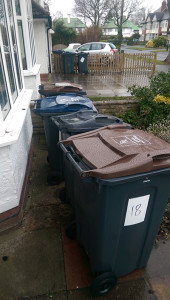
Sigh, this is about bins again. I hated myself for writing about bins this time last year. As an aside, the Council refused to be flexible about that so we’ve largely given up recycling. Leaving an extra redundant bin outside of our house. Today we got another bin we didn’t ask for. We’ve got a lot of bins.
The opposition in Birmingham to the garden waste charge is legendary. Variously labelled as a tax on owning a garden or simply the last human right the Conservatives would leave us with; there is a belief that all waste from your garden should be taken away within the Council Tax. I’m not really bothered, if we’ve got to make massive cuts to social care then I will stump thirty odd quid a year to have some leaves taken away. In the scheme of things it’s not that important.
That doesn’t mean the whole thing doesn’t infuriate me.
Being a conscientious citizen, and being the proud of owner of ton of leaves from last year, I eagerly went to renew my garden waste subscription. Clicking on the link in the friendly Birmingham City Council email it wasn’t hard to find out how to do it.
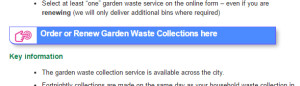
Eagerly clicking on the link I knew it was only a matter of time before I could once again get to use my only genuine skill. My ability to remember all of my payment details without once having to look at a card.
That was until I met this form.
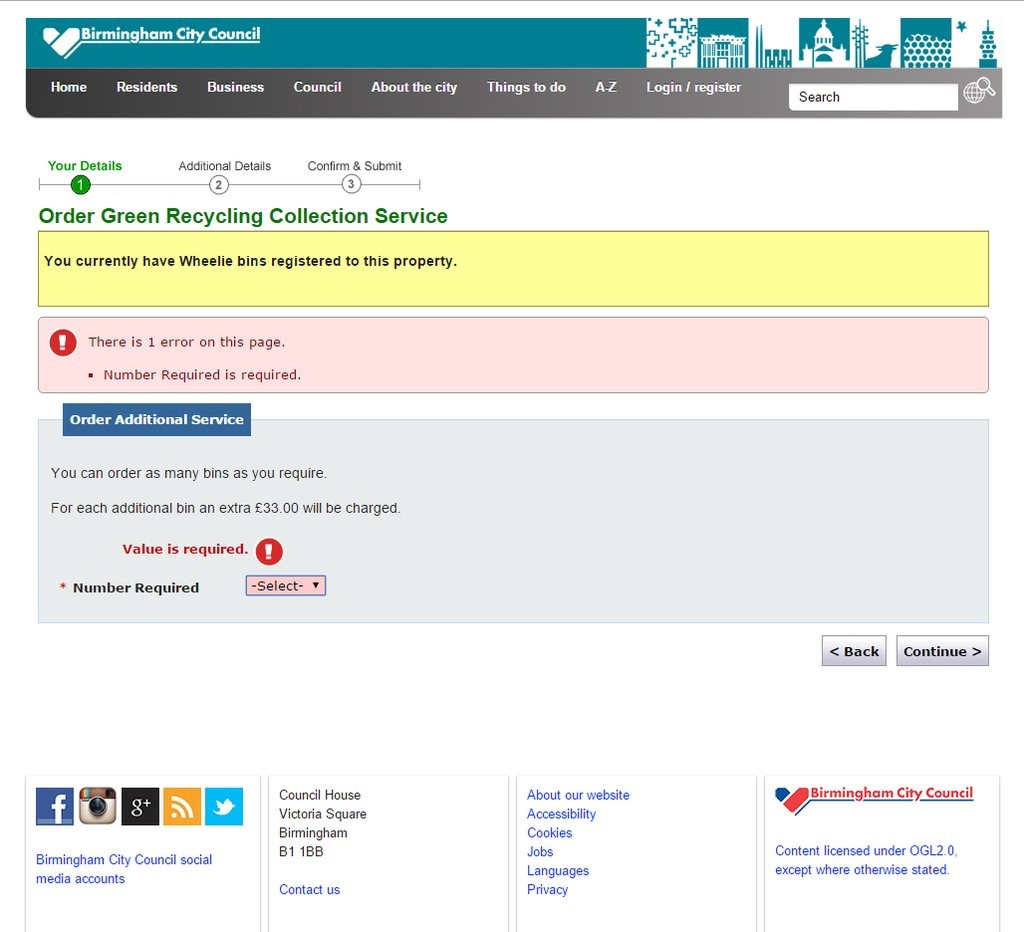
What are you supposed to do with this? It knows I have a bin registered at my property but insists I have to pick a number for an additional bin. As it was only days from the next collection I assumed that some step must be in place to filter renewals from additional orders. Be that some sort of psychic check or even someone just ringing me up.
Apparently not. Today I got my new bin to add to my collection of increasingly redundant bins. Not to worry I thought (this is completely untrue I was actually irritated like I haven’t been in years), a quick call and this will all be sorted. Except there isn’t a contact number anywhere. Fifteen minutes on the City Council web chat won me the right to ring waste management. I was told that there is a wait of twenty working days to remove a bin delivered in error. Yes, a full calendar month.
Now this could be a story of amusing incompetence but I think it points to a symptomatic flaw.
That web form was clearly designed for new customers, little thought (or I would maintain no thought) has been given to renewals. In the third year of the garden waste charge renewals are going to be the predominant users of the form. That means my error is going to be repeated.
There is an obvious and simple solution. Just amend the web form so that the drop down has an option of “Just renew”. Or if that is a particular programmatic challenge just add a zero at the top of the list. Maybe half an hours work.
But things aren’t that simple at Birmingham City Council. Because of the separation between the supplier (Service Birmingham) and customer (whatever the waste management directorate is called these days) this simple change is something that is likely to have a significant cost implication to it. I’ve no idea what the cost to get a simple change to a web page might be but I assume it must be greater than the cost of :-
- Supplying me with a bin
- Supplying me with the leaflets about garden waste
- The cost of managing my web chat
- The cost of dealing with my call to the call centre
- Sending someone to collect my bin
- Removing the number from the side of my bin
All of this, times the number of people this has happened to. Of course this could be pure hysteria on my part. It’s entirely possible that as the orders come in the waste directorate can instinctively tell a renewal from a new order. But I would suggest the cost purely to deal with my issue has to be greater than paying someone to add a zero to a drop down menu. At least I would hope so.
Interestingly if you look at my bullet point list above you might notice that the webchat and call centre are managed by Service Birmingham. Theoretically that means they will get paid more money because I’m forced to engage through two channels (it’s the jargon) in order to clear up their error.
It’s simple things like this that save money and make the Council less irritating.
Posted in Birmingham, Politics | Comments (0)